
Top 10 Child Support Myths
MYTH: No one pays child support
FACT: Over $990 Billion dollars is exchanged between over 398 million people worldwide. In the United States alone, over $220 Billion dollars is exchanged every year between over 39 million people. This is in addition to the $31 billion collected by the federal government.
Source: US Census Bureau. Families & Living Arrangements. US Census Bureau: census.gov/hhes/families/ & Children & Well Being. Retrieved from US Census – Children: census.gov/hhes/socdemo/children/data/sipp/well2009/tables.html
MYTH: All child support goes through the government
FACT: State, federal and tribal agencies focus on providing services for parents who currently or previously received government assistance for their children. In fact, only 12% of the child support collected from government agencies are from parents who have never received assistance even though only 2% of the US population has received these benefits. The remaining parents must figure out a way to manage support payments on their own.
MYTH: Once your divorce is final all our issues go away.
FACT: In most cases, divorces that occur when children are involved do not make it easier for the parents, in fact, issues become much worse. It’s quite ironic that the main drivers of divorce are money and communication, yet when you are divorced with children, you have to communicate about money.
MYTH: Child support is finalized during my divorce.
FACT: Modifications occur more frequently than original child support orders. Anytime income, time with the child or additional monetary requirements are needed for children, a child support modification can be made.
MYTH: Child support is a simple once a month payment.
FACT: Unfortunately, no. Child support requires on-going communication, negotiation, agreement, and the exchange of money. Child support is the combination of a fixed base monthly payment, specific court ordered incremental expenses, and subsequently negotiated incremental expenses. These include basic living expenses as well as any expenses related to medical, education or anything else deemed “necessary” for the child. These incremental expenses must be split and shared monthly between the parents with reimbursement to each parent and/or payments made directly to 3rd parties. Adding to the conflict and complexity, the incremental expenses typically have extremely vague guidelines set by the court order.
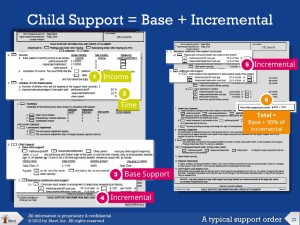
A California Child Support Order – All fields are optional and are defined by either the parent or the judge.
Therefore, until all their children turn at least 18 years old, the two parents must continue to:
- negotiate items that will be considered incremental expenses
- follow any court ordered or state mandated regulations
- document, justify and communicate incremental expenses
- split and share incremental expenses according to the court order percentages
- calculate the proper payments
- make payments to each other or to 3rd parties directly
- act as a bill collector
- keep detailed records for potential future disputes or modifications
- produce documentation and calculations for filing taxes every year
Today, parents unsuccessfully create their own unique process, workflow, and manual systems in an attempt to satisfy these requirements.
MYTH: There is a standard way to manage child support.
FACT: Even though this is a painful, costly and time consuming process for a large population, there has not been a standard system or process available to assist parents in managing child support payments. In fact, this is why Ittavi was formed. We want to address a big problem felt by a large population.
MYTH: Getting a child support modification is easy.
FACT: If parents are unable to come to an agreement on child support modification, they must go back to court in order to get a child support modification case heard. Each party is required to provide detailed information on previous or historical child support payments as well as fill out as many as 32 pages of documents. If a parent hasn’t been tracking what has or has not been paid, this can be a very time consuming and painful process.
MYTH: I don’t need to track my child support payments.
FACT: If you are making any child support payments, it is critical that you have a detailed record of your payments. Even if your payments are being made through a state system, personal tracking is critical. In fact, child support systems are very prone to error with many reports of mistakes in child support payment tracking. In fact, in the state of Ohio, a class action lawsuit was filed claiming that Ohio overcharged 114,000 non-custodial parents some $176 million. Read more about it here: Ohio Child Support Overpayment.
MYTH: I have to hire a lawyer & go to court for a child support order.
FACT: Parents can, and are encouraged to, come to a parental agreement when it comes to child support payments. In fact, it is 85% faster and thousands of dollars cheaper if parents are able to agree on payment terms. When parents are making an agreement they should also address how payments will be made and managed.
MYTH: She is getting re-married so my life is about to get much easier.
FACT: You are one relationship away from an even bigger child support issue. Whether its your new partner who believes you are paying too much or her new husband who thinks you aren’t paying enough, the more families become blended the bigger the issues. Having a system that enables parents to manage, track and communicate without having to talk directly to each other can be beneficial to all.
2 Comments. Leave new
When will paying non-custodial parents get a break for paying.. We work for the money, pay the taxes on it, it’s included in our “Net Income” for anything even though we never ever see a cent of this, not to mention we pay 75$ a year just to pay child support.. If a non custodial parent marries someone who has money, the custodial parent can get a cut, but it doesn’t work in return When the Custodial parents marries wealth, then child support will not drop, seems like the system is out to shaft paying parents, while the non paying parents squeak by unscathed, and the abusive custodial parents will always rein superior in the courts eyes. I can see why people snap.
Digi, Sounds like you are really going through it right now. The system IS so frustrating and can make it harder. I would love to have you try out SupportPay (for Free) and let me know what you like! Thanks for the comment!